The Buildings Of England - Hertfordshire
Publisher: Penguin
Format: Paperback
ISBN: none
Most people travel through Hertfordshire without giving its buildings a great deal of thought. They admire an attractive church, notice an unusually grand house, complain about an ugly modern development and continue on their way. Nikolaus Pevsner, however, was constitutionally incapable of such casual indifference. Give him a medieval doorway, a Georgian window or an obscure parish church, and he would immediately begin investigating its date, architectural significance and the unfortunate decisions of everyone who had subsequently attempted to improve it.
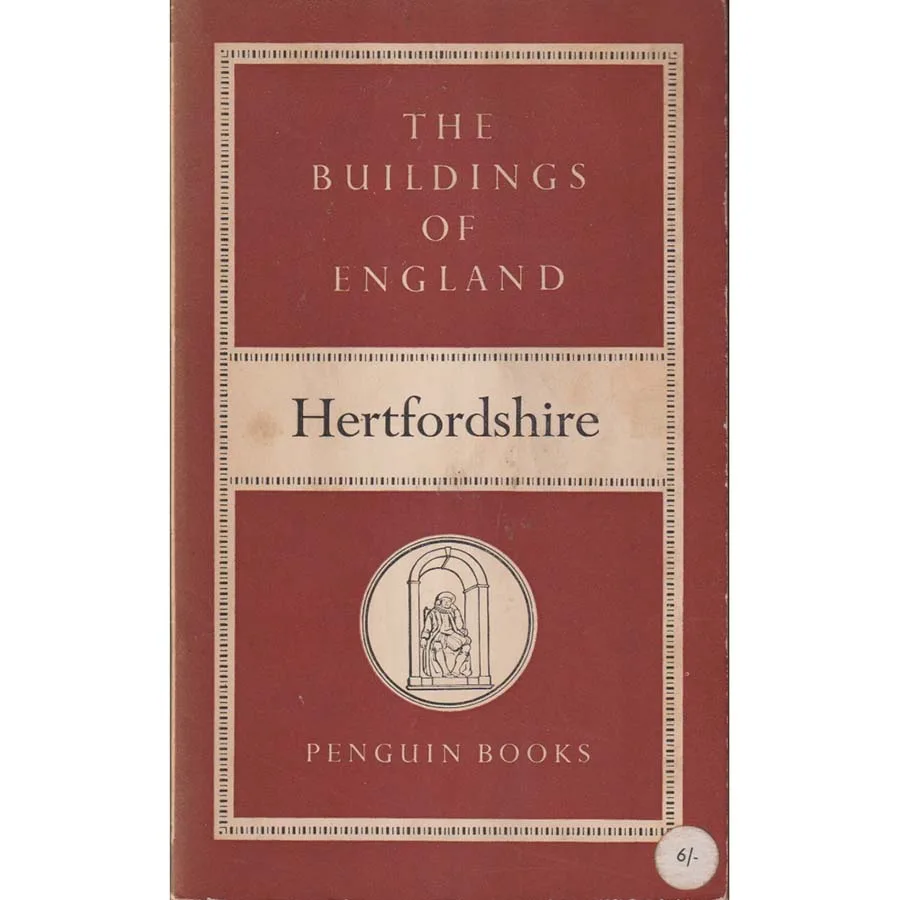
The Buildings of England: Hertfordshire (1953), by Nikolaus Pevsner and published by Penguin, is a classic volume from one of the most ambitious architectural publishing projects ever undertaken in Britain. Pevsner set himself the extraordinary task of documenting the country’s significant buildings, county by county, apparently having concluded that ordinary hobbies were insufficiently demanding.
Hertfordshire provides particularly rewarding territory for such an enterprise. Its historic market towns, ancient churches, country houses, timber-framed buildings and architectural curiosities reveal centuries of changing fashions, fortunes and social ambitions. From medieval craftsmanship to Georgian elegance and Victorian enthusiasm, the county offers a fascinating record of the English determination to construct impressive buildings and then spend subsequent generations altering them.
Pevsner approaches his subject with characteristic precision, combining historical research, architectural description and the occasional wonderfully uncompromising judgement. He was not a man inclined to praise a building merely because its owner had spent a considerable amount of money constructing it.
Churches receive particular attention, their towers, windows, monuments and interior features examined with the enthusiasm of someone who considered an interesting Norman capital more exciting than an entire afternoon of conventional entertainment.
Yet the attraction of Pevsner’s guides extends far beyond architectural specialists. They transform familiar places into historical discoveries, revealing remarkable details concealed behind ordinary streets and encouraging readers to look upwards occasionally rather than proceeding through life exclusively concerned with what is directly in front of them.
Published in 1953, this original Hertfordshire volume also possesses considerable historical interest. It records buildings and architectural assessments from a particular moment in post-war Britain, before decades of redevelopment, restoration and changing conservation priorities altered aspects of the county.
Later editions of the series have expanded and revised the original scholarship, but these early Penguin volumes retain a distinctive charm and an important place in the history of British architectural appreciation.
There is something gloriously eccentric about the entire undertaking. While most people were recovering from the war and enjoying the prospect of a more comfortable future, Pevsner was travelling around Britain cataloguing churches, examining doorframes and deciding whether particular buildings deserved architectural immortality.
Condition: Very Good. This 1953 Penguin edition is a well-preserved vintage copy, showing only modest signs of age and handling. An attractive survivor from the early years of a publishing series that became an indispensable reference for architectural historians and enthusiasts.
Offered by Crappy Old Books, where we appreciate historic buildings, admire the people determined to preserve them and occasionally wonder whether our own premises might one day qualify for a brief architectural description. Probably not, although Pevsner might have found the name interesting.
No ISBN, naturally. In 1953, books were still permitted to exist without one, just as buildings were allowed to stand for centuries without displaying a QR code.
A splendid collectible volume for Hertfordshire historians, architecture enthusiasts, Pevsner collectors and anyone who suspects that even the most unassuming English village may conceal a masterpiece worth crossing the road to inspect.
Keep browsing: See more Architecture books Other books by Nikolaus Pevsner